
Long-acting insulin names include Lantus, Toujeo, Tresiba, Basaglar, and Semglee. These insulin products help provide background insulin coverage to manage blood sugar between meals and overnight. Their active ingredients, duration of action, and available formulations vary, so understanding the differences is important when researching diabetes treatment.
If you’re looking for a clear list of long-acting insulin names, this guide brings together common brand names and their generic ingredients in one place. You’ll learn about insulin glargine and insulin degludec, discover how different formulations compare, and understand what to know about their availability. Some products, including Levemir (insulin detemir), are being discontinued in certain markets, so current availability depends on your location. <Cite refs={[“turn245064search1″,”turn245064search2″,”turn245064search11”]}/> Whether you’re a patient, caregiver, student, or researcher, this guide will help you understand the terminology and prepare more informed questions for your healthcare professional. Because insulin products are not always interchangeable, never switch brands or change your dose without medical guidance.
Long Acting Insulin Names You May Encounter in Current References
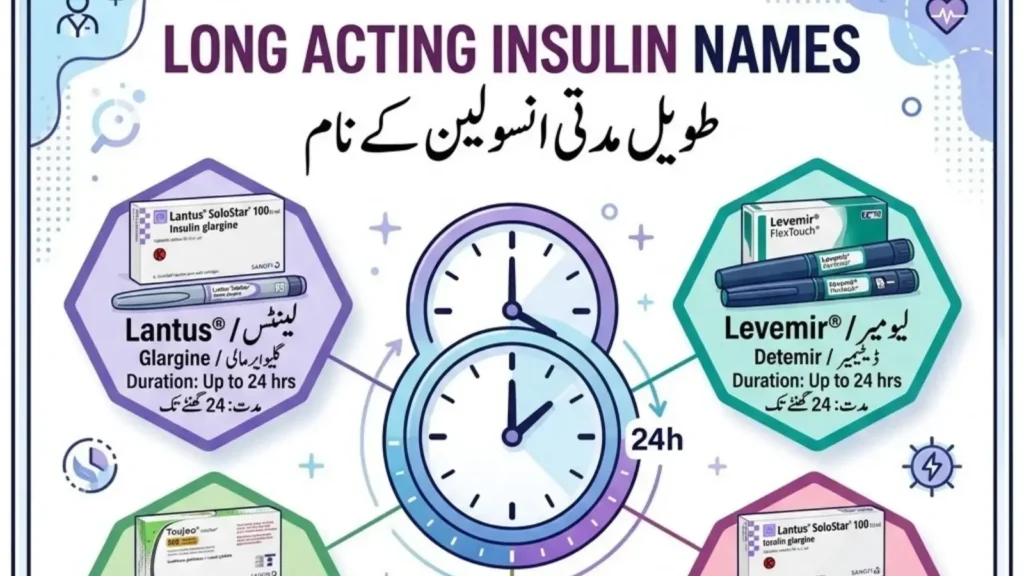
The most important first step is separating genuine long-acting products from intermediate-acting and rapid-acting insulins.
- Insulin glargine — a long-acting insulin analog.
- Lantus — a brand containing insulin glargine.
- Basaglar — a brand containing insulin glargine.
- Toujeo — a concentrated insulin glargine product.
- Insulin degludec — an ultra-long-acting basal insulin.
- Tresiba — a brand containing insulin degludec.
- Insulin detemir — a long-acting insulin analog.
- Levemir — the brand associated with insulin detemir in FDA reference material.
- Glargine U-100 — a 100-units-per-mL concentration of insulin glargine.
- Glargine U-300 — a more concentrated formulation of insulin glargine.
- Degludec U-100 — a 100-units-per-mL formulation.
- Degludec U-200 — a 200-units-per-mL formulation.
- Basal insulin — the clinical role generally associated with long-acting insulin.
- Long-acting insulin analog — a category that includes several modern basal insulins.
- Ultra-long-acting insulin — a description commonly used for insulin degludec.
The FDA lists Basaglar, Lantus, Levemir, Toujeo, and Tresiba among insulin products classified as long-acting in its consumer reference, while newer FDA material distinguishes degludec as ultra-long-acting.
Long Acting Insulin Names and Their Active Ingredients
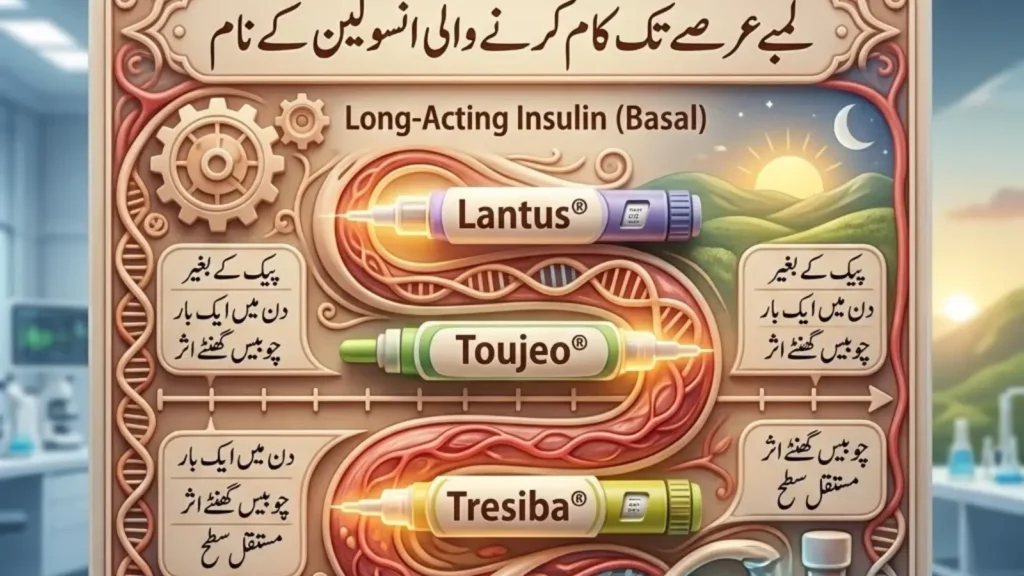
A brand name and an active ingredient are not the same thing. Knowing both can help prevent confusion when prescriptions change.
- Lantus → insulin glargine — the active ingredient is glargine.
- Basaglar → insulin glargine — another glargine product.
- Toujeo → insulin glargine — also contains glargine.
- Tresiba → insulin degludec — contains degludec.
- Levemir → insulin detemir — historically associated with detemir.
- Glargine — the generic insulin ingredient name.
- Degludec — the generic insulin ingredient name.
- Detemir — another insulin analog ingredient.
- Glargine U-100 — glargine at 100 units/mL.
- Glargine U-300 — concentrated glargine at 300 units/mL.
- Degludec U-100 — degludec at 100 units/mL.
- Degludec U-200 — concentrated degludec at 200 units/mL.
- Brand identification — tells you the marketed product.
- Nonproprietary identification — tells you the active insulin ingredient.
- Ingredient verification — should be performed before switching products.
The FDA emphasizes recording the insulin’s name and dose and discussing insulin products with a healthcare professional.
Long Acting Insulin Names Compared by Duration

Duration is one of the biggest reasons patients search for different basal insulin names. Actual response can vary between individuals.
- Glargine U-100 — generally provides prolonged basal coverage.
- Glargine U-300 — designed as a longer-lasting concentrated glargine formulation.
- Degludec U-100 — provides very prolonged basal activity.
- Degludec U-200 — contains the same active insulin as U-100 at a different concentration.
- Detemir — provides long-acting basal coverage but may have a shorter duration in some people.
- No pronounced peak — commonly describes glargine’s basal action.
- No pronounced peak — also describes degludec’s pharmacodynamic profile.
- Extended basal effect — helps explain why these products are not primarily meal-time insulins.
- Overnight coverage — one reason basal insulin is prescribed.
- Between-meal coverage — another purpose of basal insulin.
- Daily basal replacement — a central concept in insulin therapy.
- Individual duration — can differ among patients.
- Dose timing — depends on the specific insulin and prescription.
- Concentration — affects how much insulin is contained in each milliliter.
- Prescribed schedule — should take priority over generalized duration charts.
FDA materials report prolonged profiles for glargine and degludec, while professional diabetes education materials describe degludec and concentrated glargine as ultra-long-acting options.
Long Acting Insulin Names Versus Intermediate-Acting Insulin
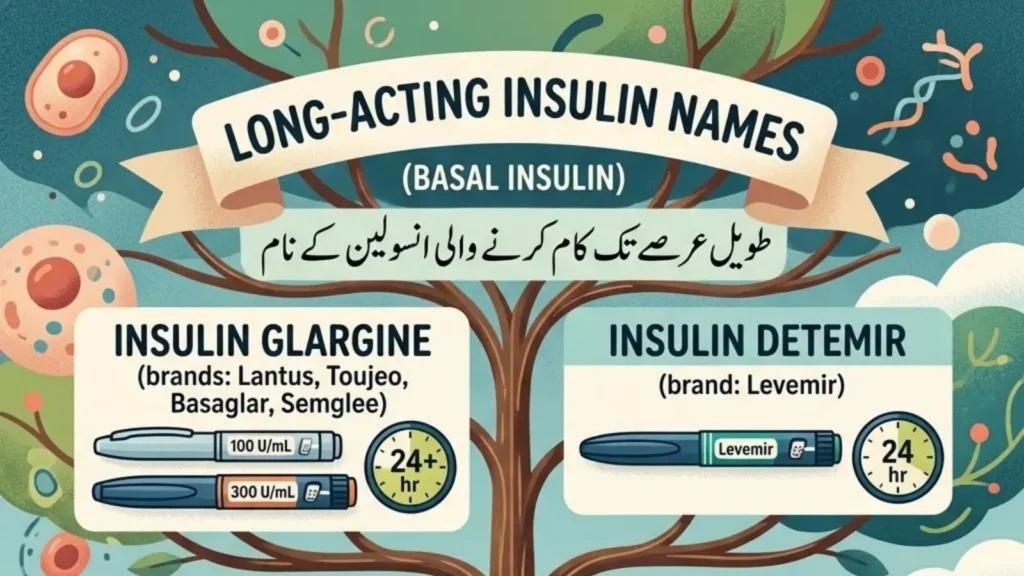
One of the most common sources of confusion is treating every insulin that lasts many hours as “long acting.”
- NPH insulin — generally classified as intermediate-acting.
- Humulin N — contains NPH insulin.
- Novolin N — contains NPH insulin.
- Glargine — classified as long acting.
- Degludec — classified as ultra-long acting.
- Detemir — classified as long acting in FDA references.
- NPH peak — NPH has a more noticeable peak than many basal analogs.
- Basal analogs — are designed to provide prolonged background insulin.
- Intermediate acting — is a separate insulin category.
- Premixed insulin — can contain NPH plus another insulin.
- Humulin 70/30 — contains NPH and regular insulin.
- Novolin 70/30 — also combines NPH with regular insulin.
- Ryzodeg 70/30 — combines degludec with insulin aspart.
- Classification matters — different insulin categories should not be assumed interchangeable.
- Professional guidance matters — switching insulin requires appropriate medical direction.
The FDA classifies Humulin N and Novolin N as intermediate-acting, while glargine, detemir, and degludec are listed as long-acting or ultra-long-acting products.
Long Acting Insulin Names for Basal Insulin Therapy
Basal insulin is intended to address the body’s background insulin requirement rather than directly cover a particular meal.
- Basal coverage — background insulin support.
- Overnight glucose control — an important basal objective.
- Between-meal glucose control — another basal objective.
- Fasting glucose — can be influenced by basal insulin.
- Type 1 diabetes — requires insulin because the body makes little or no insulin.
- Type 2 diabetes — some people eventually require insulin.
- Basal-bolus therapy — combines basal and meal-related insulin.
- Bolus insulin — generally addresses meals or corrections.
- Basal-only treatment — may be used in selected type 2 diabetes situations.
- Daily injection — common for several basal products.
- Flexible scheduling — depends on the individual product.
- Glucose monitoring — helps evaluate treatment response.
- Dose adjustment — should be individualized.
- Treatment goals — differ among patients.
- Clinical supervision — is important when beginning or changing insulin.
The FDA notes that people with type 1 diabetes need insulin every day, while some people with type 2 diabetes also need insulin depending on their individual circumstances.
Long Acting Insulin Names and Common Brand Recognition
Recognizing a familiar brand can be useful, but the active ingredient should always be checked as well.
- Lantus — insulin glargine.
- Basaglar — insulin glargine.
- Toujeo — insulin glargine.
- Toujeo Max — a higher-capacity Toujeo presentation.
- Tresiba — insulin degludec.
- Tresiba FlexTouch — a pen presentation of Tresiba.
- Levemir — insulin detemir in FDA references.
- Lantus SoloStar — a pen presentation of Lantus.
- Basaglar KwikPen — a pen presentation of Basaglar.
- Glargine — active ingredient behind several brands.
- Degludec — active ingredient behind Tresiba.
- Detemir — active ingredient historically marketed as Levemir.
- U-100 — indicates 100 units per mL.
- U-200 — indicates 200 units per mL.
- U-300 — indicates 300 units per mL.
FDA product information demonstrates why checking both brand and ingredient is important: several different brand names can contain insulin glargine.
Long Acting Insulin Names and Concentration Differences
Concentration can make two insulin pens look similar while delivering different amounts of insulin per milliliter.
- U-100 — contains 100 insulin units per mL.
- U-200 — contains 200 insulin units per mL.
- U-300 — contains 300 insulin units per mL.
- Glargine U-100 — used in products such as Lantus.
- Glargine U-300 — used in Toujeo.
- Degludec U-100 — available in Tresiba formulations.
- Degludec U-200 — another Tresiba concentration.
- Same ingredient — does not necessarily mean same concentration.
- Different concentration — does not automatically mean a different insulin family.
- Pen labeling — should be checked carefully.
- Prescription strength — matters when filling an insulin prescription.
- Units versus milliliters — are not interchangeable concepts.
- Dose display — should be understood before injection.
- Concentration errors — can cause serious dosing problems.
- Pharmacist confirmation — is appropriate when a product appears different.
Never convert insulin doses between products based solely on concentration or an internet chart. FDA guidance specifically warns that insulin switching requires medical supervision.
Long Acting Insulin Names and Injection Timing
The correct timing depends on the insulin prescribed, the patient’s treatment plan, and the product’s instructions.
- Once-daily dosing — applies to many basal regimens.
- Twice-daily dosing — may be used with some insulin regimens.
- Morning dosing — is used for some patients.
- Bedtime dosing — is used for some patients.
- Consistent timing — can be important for certain products.
- Degludec — has a particularly prolonged action.
- Glargine — is commonly used as basal insulin.
- Detemir — has historically been used once or twice daily.
- Meal timing — is different from basal insulin timing.
- Rapid insulin — is commonly associated with meals.
- Basal insulin — provides background coverage.
- Missed dose — should be handled according to product instructions and professional advice.
- Late injection — should not automatically trigger an extra dose.
- Double dosing — can cause dangerous hypoglycemia.
- Personal schedule — should come from the prescribed treatment plan.
The FDA states that injection frequency varies among people and depends on insulin type and other factors; the prescribing healthcare professional determines the schedule.
Long Acting Insulin Names and Side Effects to Know
Insulin can lower blood glucose effectively, but users need to understand potential adverse effects, especially hypoglycemia.
- Hypoglycemia — blood glucose that becomes too low.
- Sweating — can occur during low blood glucose.
- Shakiness — can accompany hypoglycemia.
- Hunger — may be an early warning symptom.
- Confusion — can occur during significant hypoglycemia.
- Dizziness — may accompany low glucose.
- Fast heartbeat — can occur with hypoglycemia.
- Injection-site reactions — can occur with insulin injections.
- Lipodystrophy — repeated injections in one area can contribute to abnormal fatty tissue changes.
- Injection-site rotation — helps reduce repeated-site problems.
- Low glucose risk — depends on insulin dose and individual circumstances.
- Food intake — can influence glucose levels.
- Physical activity — can affect insulin requirements and glucose.
- Other medicines — may affect glucose management.
- Emergency symptoms — severe hypoglycemia requires urgent attention.
Because insulin can cause low blood glucose, people should learn their individualized hypoglycemia plan from their healthcare team rather than relying on a generic internet dosing rule.
Long Acting Insulin Names and Type 1 Diabetes
For people with type 1 diabetes, basal insulin is an essential part of replacing insulin the body can no longer adequately produce.
- Type 1 diabetes — involves little or no endogenous insulin production.
- Basal insulin — provides background replacement.
- Meal insulin — covers carbohydrate-containing meals.
- Correction insulin — may address elevated glucose when prescribed.
- Basal-bolus regimen — is a common insulin strategy.
- Continuous glucose monitoring — can help track glucose patterns.
- Insulin pump therapy — delivers insulin continuously through a device.
- Injection therapy — is another method of insulin delivery.
- Glargine — can serve as basal insulin.
- Degludec — can serve as basal insulin.
- Detemir — has been used as basal insulin.
- Basal consistency — supports predictable treatment planning.
- Glucose trends — help clinicians evaluate therapy.
- Illness — can change insulin needs.
- Medical planning — is essential when insulin requirements change.
The FDA states that people with type 1 diabetes make very little or no insulin and must take insulin every day to stay alive.
Long Acting Insulin Names and Type 2 Diabetes
Long-acting insulin can also be part of type 2 diabetes treatment when lifestyle measures and other medications do not provide sufficient glucose control.
- Type 2 diabetes — involves inadequate insulin production, insulin resistance, or both.
- Basal insulin — may be introduced as part of treatment.
- Fasting glucose — is often considered when evaluating basal therapy.
- A1C — provides a longer-term view of glucose control.
- Medication combinations — vary by patient.
- Lifestyle measures — remain relevant to diabetes management.
- Glucose monitoring — can support treatment decisions.
- Insulin initiation — should follow an individualized clinical plan.
- Dose titration — should be directed appropriately.
- Hypoglycemia education — is important after starting insulin.
- Weight considerations — may influence treatment discussions.
- Kidney function — can affect diabetes treatment decisions.
- Other health conditions — can influence insulin selection.
- Treatment adherence — matters for achieving glucose goals.
- Follow-up — helps determine whether therapy is working.
The FDA notes that some people with type 2 diabetes need insulin when their bodies do not make enough insulin or do not use it effectively.
Long Acting Insulin Names and Biosimilar Options
The insulin market can include reference products and biosimilar products, making the relationship between brand and ingredient increasingly important.
- Reference product — is the established biologic against which a biosimilar is compared.
- Biosimilar — is designed to be highly similar to its reference product.
- Insulin glargine biosimilars — are an important part of the current market.
- Lantus — is a reference insulin glargine product.
- Langlara — FDA lists insulin glargine-aldy as its active ingredient and Lantus as its reference product.
- Insulin glargine-aldy — is the nonproprietary identification for Langlara.
- FDA approval — establishes regulatory authorization for a product’s indicated use.
- Interchangeability — is a specific regulatory designation and should not be assumed from the word “biosimilar.”
- Pharmacy substitution — depends on applicable regulations and product status.
- Insurance formularies — can influence which product is offered.
- Copay — may differ between products.
- Availability — can vary by pharmacy and region.
- Product labeling — provides authoritative instructions.
- Prescriber involvement — remains important when changing insulin products.
- Pharmacist involvement — can help clarify product substitutions.
The FDA’s current biosimilar database lists Langlara, insulin glargine-aldy, as a biosimilar to Lantus, with an approval date of April 2026.
Long Acting Insulin Names and Safety When Switching
Changing insulin is not simply a matter of choosing another name from a list. Different products can have different concentrations, action profiles, and instructions.
- Do not switch independently — consult an appropriate healthcare professional.
- Do not assume unit-for-unit equivalence — unless specifically instructed.
- Check the active ingredient — before accepting a replacement.
- Check concentration — such as U-100, U-200, or U-300.
- Check the device — pen and vial presentations differ.
- Read the label — every time a new product is supplied.
- Confirm the dose — with a pharmacist when uncertain.
- Confirm timing — after any prescribed product change.
- Monitor glucose — more closely when clinically advised during transitions.
- Watch for hypoglycemia — especially after a change.
- Watch for hyperglycemia — particularly if insulin delivery is inadequate.
- Never share insulin pens — even if a new needle is attached.
- Use appropriate injection technique — according to professional instruction.
- Store insulin correctly — according to its product labeling.
- Seek urgent help for severe symptoms — rather than trying to correct a dangerous situation alone.
FDA guidance specifically states that switching insulin products should be done in consultation with a physician and with medical supervision.
Long Acting Insulin Names and Choosing Between Options
There is no single long-acting insulin that is automatically best for everyone. Selection depends on clinical and practical factors.
- Diabetes type — affects treatment planning.
- Current glucose pattern — can influence basal selection.
- Fasting glucose — may be relevant when adjusting basal treatment.
- Hypoglycemia history — is important to discuss.
- Injection frequency — can influence convenience.
- Dose size — can make concentration relevant.
- Pen preference — may affect ease of administration.
- Insurance coverage — can influence access.
- Medication cost — matters for long-term adherence.
- Availability — varies by location.
- Other medicines — may affect the overall diabetes plan.
- Kidney health — can influence clinical decisions.
- Liver health — may also be relevant.
- Lifestyle schedule — can affect practical treatment considerations.
- Clinician experience — supports individualized selection.
The appropriate insulin depends on the person’s medical circumstances, and the FDA advises patients to discuss their insulin choice with their healthcare provider.
Long Acting Insulin Names: A Quick Reference Guide
A concise reference can make it easier to remember the relationship between major long-acting insulin ingredients and their commonly recognized products.
- Glargine — long-acting insulin analog.
- Lantus — glargine brand.
- Basaglar — glargine brand.
- Toujeo — concentrated glargine brand.
- Degludec — ultra-long-acting basal insulin.
- Tresiba — degludec brand.
- Detemir — long-acting insulin analog.
- Levemir — detemir brand in FDA references.
- U-100 — 100 units/mL concentration.
- U-200 — 200 units/mL concentration.
- U-300 — 300 units/mL concentration.
- NPH — intermediate-acting, not generally categorized as long acting.
- Humulin N — NPH product.
- Novolin N — NPH product.
- Ryzodeg 70/30 — contains both long-acting degludec and rapid-acting aspart, so it is a combination rather than a pure basal insulin.
The FDA’s insulin reference distinguishes long-acting products from NPH and mixed formulations, which is why simply searching for “insulin that lasts a long time” can produce confusing results.
Frequently Asked Questions
1. What are the main long acting insulin names?
Commonly recognized names include Lantus, Basaglar, Toujeo, Tresiba, and Levemir in FDA reference materials. Their active ingredients include insulin glargine, insulin degludec, and insulin detemir. Availability and labeling can change, so current local product information should be checked.
2. What is the difference between Lantus and Tresiba?
Lantus contains insulin glargine, while Tresiba contains insulin degludec. Degludec has an especially prolonged duration of action and is classified as ultra-long acting in FDA materials.
3. Is NPH a long acting insulin?
NPH, including products such as Humulin N and Novolin N, is generally classified as intermediate-acting insulin, not long-acting insulin.
4. What is basal insulin?
Basal insulin provides background insulin coverage between meals and overnight. Long-acting insulin analogs are commonly used for this purpose.
5. Can I switch from one long acting insulin to another?
Do not make the change yourself. Different products can have different concentrations, pharmacologic characteristics, and dosing instructions. FDA guidance recommends medical supervision when switching insulin products.
6. What does U-100, U-200, or U-300 mean?
These labels describe insulin concentration: U-100 contains 100 units per milliliter, U-200 contains 200 units per milliliter, and U-300 contains 300 units per milliliter. They should not be treated as interchangeable products without professional instructions.
7. Which long acting insulin is best?
There is no universally best option. The appropriate insulin depends on factors such as diabetes type, glucose patterns, hypoglycemia risk, dose requirements, cost, availability, other medicines, and individual medical circumstances.
8. Are long acting insulin names the same everywhere?
Not necessarily. Brand availability, approved products, biosimilars, and product names can differ by country. Always verify the active ingredient and current local labeling rather than relying on an international brand-name list.
Conclusion
Understanding long acting insulin names becomes much easier when brand names and active ingredients are considered together.
The major categories include insulin glargine, insulin degludec, and insulin detemir, while NPH belongs to the intermediate-acting category.
Products can also differ by concentration, delivery device, duration, labeling, availability, and regulatory status.
The most important takeaway is that an insulin name alone is not enough to determine whether two products can be substituted.
Before changing insulin, check the active ingredient, concentration, device, prescribed dose, and timing with a qualified healthcare professional. Never use a general internet list to calculate a replacement dose.

